
How to Refinance Your Home Loan: The Step-by-Step Guide (and When It’s Not Worth It)
9 min read · Updated September 2026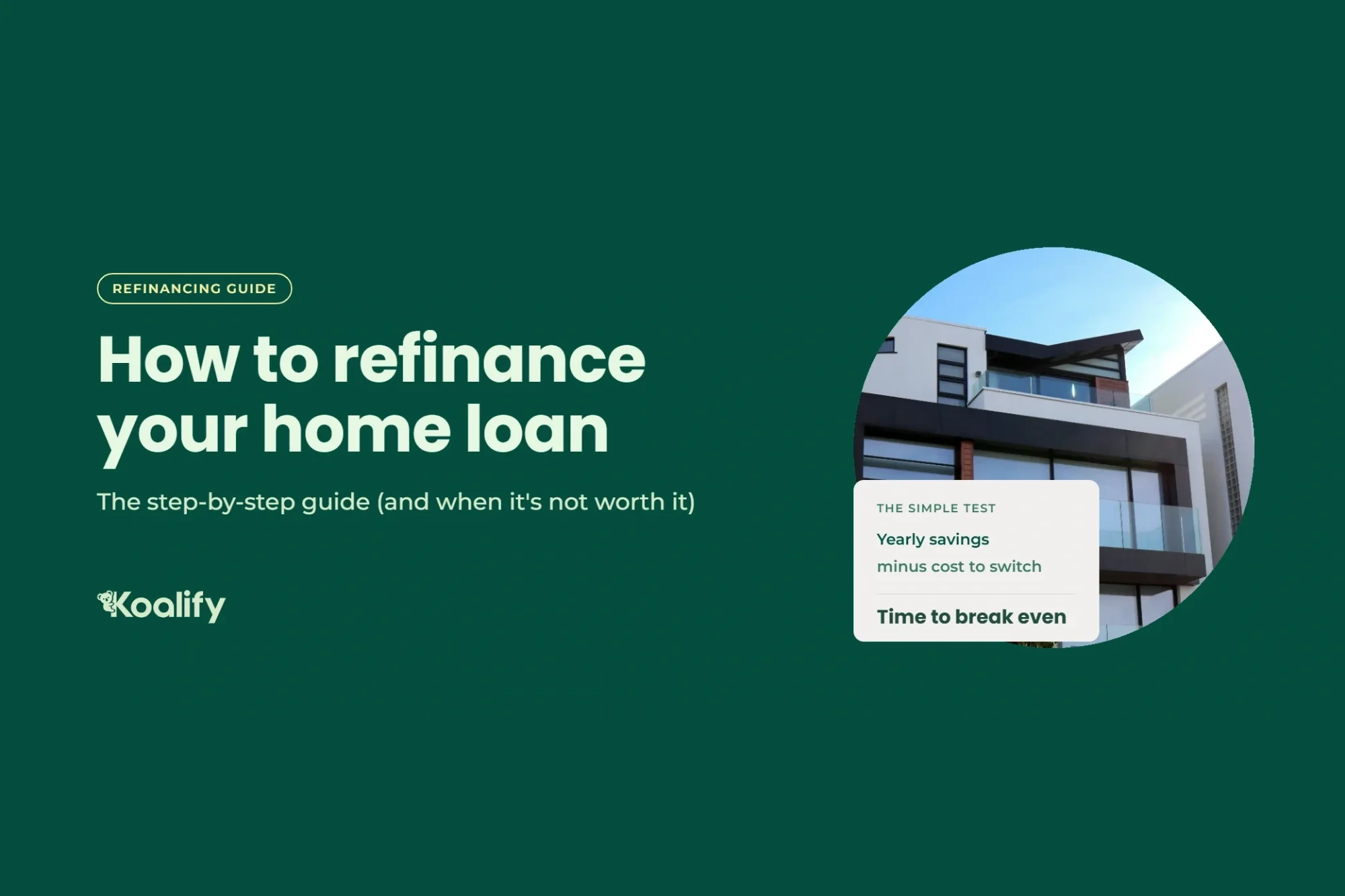
Is refinancing your home loan actually worth it?
Refinancing is worth it when you save more than it costs you to change lenders. A lot of the time that’s an easy yes. For some people, though, it can be a complete waste of time and money.
Most refinance content and marketing tells everyone to switch lenders. This guide won’t. We’ll cover when refinancing makes sense, what it really costs, how the process works step by step, and when you’re better off staying with your current home loan.
As a mortgage broker, refinancing is how I get paid. That’s exactly why I’ll tell you when it isn’t worth it.
When refinancing makes sense (and when it doesn’t)
Refinancing usually makes sense when:
You haven’t reviewed your home loan in 12 to 14 months. Banks and lenders usually save their lowest interest rates for new customers, so existing customers can drift onto a worse rate without realising.
Your fixed rate is ending and will roll onto a standard variable rate.
Your property has increased in value. More equity can mean a better rate, no lenders mortgage insurance on future borrowing, or access to equity for an investment or renovation.
You want different home loan features, like an offset account, the option to split fixed and variable, or dropping an annual package fee you don’t use.
You want to consolidate debt, like a car loan or credit card, into a lower rate.
Refinancing usually isn’t worth it when:
You’re midway through a fixed rate and the break fee would wipe out any interest savings.
Your loan is small or nearly paid off. Switching costs are roughly the same whatever the loan size, so the savings don’t always cover them.
You’re planning to sell soon. You won’t be in the loan long enough to recover the costs.
You’d have to pay lenders mortgage insurance again because you’d be borrowing above 80% of the property’s value (your LVR).
The simple test: work out what you’d save each year, subtract the cost of switching, and see how long it takes to break even. Our refinance savings calculator does the first part for you. If breaking even takes more than a year or two, think hard.
What are the costs to refinance a home loan?
For most people on a variable rate, refinancing costs somewhere in the hundreds of dollars, not thousands. Fixed rates and lenders mortgage insurance are where it gets expensive. (For the full list of fees that come with a mortgage, see our guide to home loan costs.)
Cost | What it is | Rough guide |
|---|---|---|
Charged by your current lender to close the loan | Usually $300–$350 | |
Government registration fees | Registering the new mortgage and removing the old one, set by each state | Usually $300–$350 |
Application or establishment fee | Charged by some new lenders to set up the loan | Often $0, since many lenders waive it |
Valuation | The new lender checks what your property is worth | Usually paid by the lender |
Fixed rate break fee | Charged if you leave a fixed loan before the term ends | Anywhere from $0 to many thousands, depending on how rates have moved |
Lenders mortgage insurance | Charged if you’re borrowing more than 80% of the property’s value | Can run into thousands, so avoid it if possible |
What about cashback offers? Some lenders pay cashback to switch to their home loan, often $2,000 to $3,000 upfront. It’s a real bonus, but it should never be the reason you pick a home loan, because it’s easily lost to a slightly higher rate over a few years. Look at the loan first and the cashback second.
Before you switch: ask your current lender for a better rate
Sometimes the cheapest refinance is the one where you don’t change lenders. Lenders don’t like losing customers and would rather keep you on a lower rate than lose you entirely, so a single phone call can be worth it.
How to do it:
Find out your current interest rate, and what new customers are being offered for a similar loan.
Call your lender and ask for a rate review. Tell them you’re looking at other lenders and you’ve seen better rates elsewhere, or that you’ve spoken with a broker who has found you a better rate.
Ask for the new rate in writing, and check it applies to your loan straight away, not just at your next review.
Hopefully they match or get close, and you’ve saved money with zero paperwork. If they don’t improve your rate, you’ve learned something about how much they value you as a customer.
There is a catch. Your lender will only ever show you its own products. It won’t tell you what other lenders are offering new customers. That’s where a refinance broker helps, by comparing the whole market for you.
How to refinance your home loan, step by step
From first conversation to settlement, refinancing usually takes four to six weeks. Here’s how it works:
Review your current loan. Look at your current interest rate, loan balance and fees.
Estimate your property’s value. Your property value can decide your rate and whether you’ll pay lenders mortgage insurance. The new lender will do a formal valuation.
Compare lenders, not just rates. Look at the rate, the fees, and features like offset and redraw. Check the comparison rate, as the lowest advertised rate isn’t always the best option.
Gather your documents. Usually payslips (or tax returns if you’re self-employed), recent bank statements, your current loan statements and ID.
Apply and get the valuation done. The new lender assesses your application and values your property.
Get approved and sign the loan documents. Read them, especially the rate, fees and any fixed rate terms.
Sign the discharge form for your old lender. This starts the process of closing your old loan. Your new and old lenders then arrange settlement between themselves.
Settlement. Your new lender pays out the old loan. You’ll get your new account details and your first repayment date.
After settlement: update any direct debits or salary payments that went to your old loan or offset account. It’s the step most people forget.
How much could you save by refinancing?
The size of your loan matters as much as the rate difference. Here are three simplified examples:
Big loan, variable | Small loan, variable | Big loan, breaking a fixed rate | |
|---|---|---|---|
Loan balance | $700,000 | $150,000 | $700,000 |
Rate reduction | 0.50% | 0.30% | 0.50% |
Interest saved in year one | About $3,500 | About $450 | About $3,500 |
Cost to switch | About $800 | About $800 | About $800 + $6,000 break fee |
Time to break even | About 3 months | Nearly 2 years | About 2 years |
Verdict | Easy yes | Probably not worth it | Depends how long is left on the fixed term |
The first example is why refinancing gets talked about so much. The second is why it isn’t for everyone. The third is where most people need someone to run the real numbers.
These examples are simplified. They look at year-one interest only, and your actual savings will depend on your rate, fees, loan term and repayments.
Real example: what refinancing saved one client
A business owner came to Koalify who hadn’t reviewed their home loan in five years. They’d been busy and hadn’t thought much about it. They had a $1,000,000 variable home loan with a major lender and assumed the lender was looking after them.
What we found: borrowers with similar-sized loans were paying almost a full 1% less, and new customers of their own lender were being offered much lower rates.
What we did: we went to their current bank with evidence that their rate wasn’t competitive. When the lender didn’t match or improve it, we showed the client their alternatives and what each would save them.
The result: about $10,644 a year less in interest, or $53,227 over five years.
Staying loyal to their lender had cost them almost $50,000 in extra interest, all while they assumed they were doing the right thing. It’s one of the most common mortgage traps we see.
Refinancing when you’re self-employed
Self-employed borrowers can refinance like anyone else, but there’s a trap worth knowing about first.
When you refinance, the new lender assesses you as a brand-new borrower. They look at your latest tax returns, and they test whether you could still afford the loan if rates went up. It doesn’t matter that you’ve never missed a repayment.
So if you’ve had a quieter year, or your accountant has minimised your taxable income, you can end up stuck. You can afford your loan and you’ve paid it on time for years, but on paper you don’t qualify for a cheaper one. People call this mortgage prison.
There are ways out:
Time it right. Refinance after lodging a strong year’s tax return, not after a weak one.
Use add-backs. Depreciation, one-off expenses and interest on debts being paid out can all lift the income a lender assesses.
Pick a lender with the right policy. Some lenders are more flexible for borrowers refinancing a loan they’ve been paying reliably, and some assess self-employed income more generously than others.
I’ve written a full guide on this: Self-Employed Home Loans in Australia: How Lenders Actually Assess You.
Refinancing FAQs
How long does it take to refinance a home loan in Australia?
Usually a few weeks from application to settlement. It can be faster if your documents are ready, and slower if your income is complex or the valuation comes back low. Your current lender is often the slowest part of the process.
How often can you refinance?
There’s no legal limit. Every application leaves an enquiry on your credit file, though, so it’s worth doing properly rather than often. Reviewing your loan every year or two is a good idea.
Does refinancing hurt your credit score?
A credit enquiry can cause a small, temporary dip in your credit score. Several applications in a short time look worse than one well-prepared application, so only commit to an application once you know the benefits.
Can I refinance if my property has dropped in value?
Possibly. If your loan is now more than 80% of the property’s value, you may have to pay lenders mortgage insurance again, which can wipe out your savings.
Can I refinance a fixed rate loan?
Yes, but you may pay a break fee. Get a written break cost quote first and compare it against what you’d save.
Should I refinance to a lower rate or ask my bank to match it?
Try both. Ask your current lender first, then compare what they offer against the rest of the market. Here’s why a refinance broker can help with that second step.
The bottom line
Refinancing is one of the easiest ways to save real money on your home loan, but only when the numbers actually work. Check your rate, ask your lender, work out your break-even, and don’t let a cashback offer make the decision for you.
Whether refinancing is right for you depends on your situation. That’s what I do. If you want to know whether you’re paying too much, book a free chat with me and I’ll run the numbers. If staying put is the better call, I’ll tell you.
About the author: Luke Patterson is a mortgage broker and the founder of Koalify. He helps business owners, investors and homeowners refinance, and specialises in borrowers with complex income.
This article is general information only and doesn’t consider your personal objectives, financial situation or needs. Figures are illustrative only. Speak to a broker about your specific situation, and to your accountant about any tax questions.
Related guides
What to Do When Your Fixed-Rate Home Loan Ends?
Is your fixed rate home loan about to expire? Find out what happens when it does, and the four options you have next to make sure you’re not losing money.
Read guide
How to Use a Mortgage Refinance Calculator to Save Money on Your Home Loan
Refinancing your home loan can be a smart financial move, potentially saving you thousands of dollars over the life of your loan.
Read guideFirst Home Buyer Guide: Getting Your First Home Loan
Securing financing to enter the property market can be a daunting task, especially for first-time home buyers. The process involves not only searching for the perfect property but also conducting house inspections, all while trying to secure suitable finance.
Read guideCompare rates from multiple lenders online.
Let our mortgage brokers secure the most suitable deal for you.