
What to Do When Your Fixed-Rate Home Loan Ends?

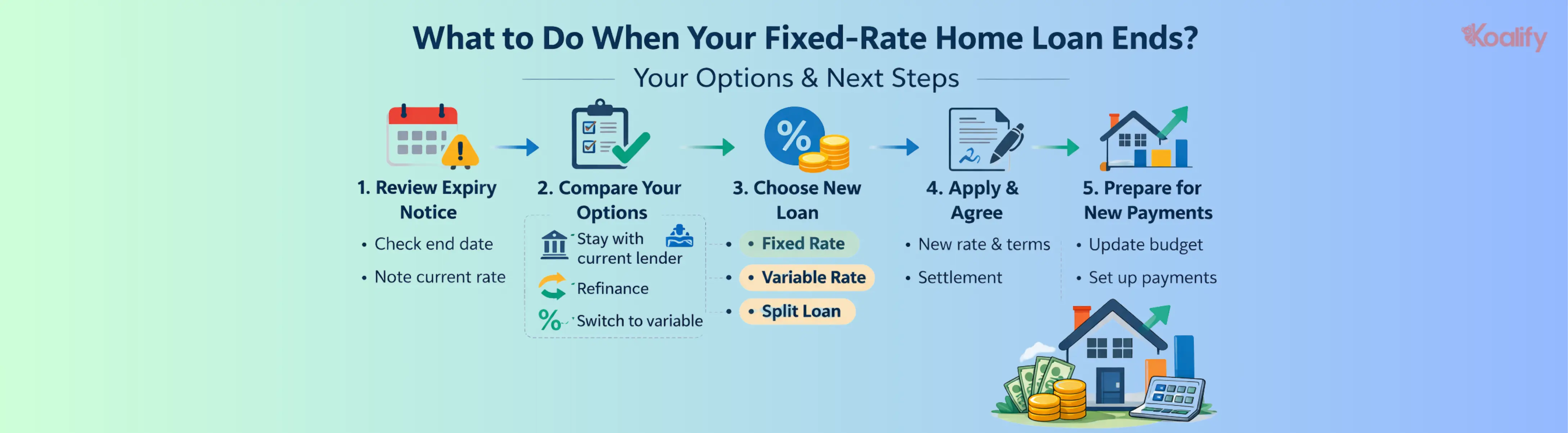
For a while there, fixed-rate home loans felt like a safety net. They offer certainty for a set period, usually two to five years, with predictable repayments since your interest rate remains the same.
But when that fixed period ends, things can change quickly. Your loan won’t be the same anymore.
The Reserve Bank of Australia had interest rates at historic lows during the pandemic. That is when many borrowers decided to fix their home loan interest rate, to benefit from the lowest interest possible at the time.
But now, many of these fixed-rate loans are nearing their expiry. This also means repayments could jump by hundreds (or even thousands).
If you’re one such borrower, it’s important to know what happens next, and what your options are to deal with this drastic change without blowing up your money.
Understanding Fixed Interest Rate Home Loans
A fixed-rate home loan is a mortgage where your interest rate is locked in for a specific period, usually between one and five years. During this fixed term:
Your interest rate stays the same
Your minimum repayments don’t change
You’re protected from interest rate increases
This can make budgeting much easier because you know exactly what your repayments will be each month.
Essentially, your lender guarantees a fixed interest rate for the agreed period. Even if the Reserve Bank of Australia increases the official cash rate during that time, your repayments won’t rise.
Benefits of a Fixed-Rate Home Loan in Australia
A fixed-rate home loan isn’t right for everyone. But it does offer several clear advantages, especially when interest rates are rising or economic conditions feel uncertain.
Repayment Certainty
Your biggest advantage is predictability.
Because your interest rate is locked in, your minimum repayments stay the same for the entire fixed period (usually 1–5 years). That makes it easier to:
Plan your household budget
Manage cash flow
Avoid repayment shocks
Even if the Reserve Bank of Australia increases the cash rate, your repayments won’t change during your fixed term.
Protection From Rate Rises
Fixed loans act as a buffer when rates are climbing.
If market interest rates increase significantly, you’re protected from those rises until your fixed period ends. This can potentially save thousands in interest during upward rate cycles.
Financial Stability for Major Life Events
Knowing your repayments won’t change can reduce financial stress during transitions. So, a fixed rate can be a great idea if you’re:
Starting a family
Changing jobs
Planning renovations
Adjusting to a single income
Managing other financial commitments
Easier Long-Term Planning
Many borrowers prioritise stability for overall financial discipline. Fixed repayments are a great way to find this stability, as it makes it easier to:
Set savings goals
Plan investments
Structure other debts
Forecast expenses with confidence
Shield From Market Volatility
Interest rates can move quickly depending on inflation, employment data, and decisions from the RBA. But having a fixed rate home loan shields you from short-term fluctuations like these.
So, What Happens When Your Fixed-Rate Home Loan Ends?
When your fixed-rate period ends, your loan doesn’t stay fixed anymore. In most cases, it automatically rolls onto your lender’s standard variable rate (SVR).
This new rate may be higher, or occasionally lower, than your fixed rate since it fluctuates with market conditions and decisions by the Reserve Bank of Australia.
If interest rates have risen since you locked in your fixed rate, your minimum repayments could now increase.
For borrowers who fixed during ultra-low rate periods, this jump can be noticeable. This is sometimes referred to as “reversion shock.”
However, the brighter side here is that your loan could now become more flexible. Because once you move to a variable rate, you typically gain access to features that may have been restricted during the fixed period, such as:
Unlimited extra repayments
Offset accounts (depending on your product)
Greater refinancing flexibility
What to Do if Your Fixed-Rate Home Loan Is Expiring? The Four Options You Have
Thankfully, you’re not locked in on falling into your lender’s standard variable rate (SVR).
Lenders will notify you in advance with the new rate and updated repayment amount, and this is when you can let them know how you want to proceed with the repayments.
1. Re-Fix Your Home Loan Repayments
If you want the same predictability and repayment stability, then your best bet would be to fix your interest rate for a new set period. The period usually ranges from 1 to 5 years, depending on your choice and lender approval.
The rate offered for re-fixing will reflect current market conditions and funding costs, which are influenced by decisions from the Reserve Bank of Australia and broader economic trends.
That mean your new rate won’t be the same as your old one. Instead, it will be based on what’s available at the time.
2. Switch to Variable Interest Rate
If you’re not interested in re-fixing the interest rate, you can ask the lender to move the loan to variable rate.
In this case, the interest rate changes according to the market.
Once you switch:
Your interest rate is applied to your remaining loan balance
Your repayments are recalculated based on the remaining term
Repayments may rise or fall over time
However, keep in mind that an automatic reversion to the lender’s standard variable rate (SVR) happens when you don’t do anything or speak with your lender. In most cases, this SVR is not the lender’s most competitive offer, so it can be pricier.
To prevent that, make sure to speak with your lender and ask for a discounted/lower variable product. Doing nothing is the most expensive option, so make sure you communicate with the lender.
3. Split Loan
Some borrowers would like to get the best of both worlds. A split mortgage is ideal if you’re one of them.
A split loan basically divides your mortgage into two portions, with one portion fixed for a set term and the other set on a variable rate. Each portion has its own interest rate and repayment calculation.
This can help you:
Lock in part of your loan for repayment stability
Keep part variable for flexibility
Make unlimited extra repayments on the variable portion
Reduce exposure if rates move unexpectedly
Since rate movements often follow decisions by the Reserve Bank of Australia, splitting can soften the impact of future increases without fully committing.
4. Refinance
In case you’re not satisfied with what your lender has to offer on the above three setups, refinancing is your best bet.
Most lenders offer discounts to new customers, so you can browse and compare different lenders and their products, and go with one that offers better rates or discounts than your current lender.
Finding the Best Deal Possible
To find the right solution, you’d have to do cost-benefit analysis with all the possible scenarios and outcomes. While it can take a lot of time and effort, it’s worth it since you’ll likely be able to save some money on the home loan.
You may also consult a mortgage broker to get this done for you. A good broker will evaluate your circumstances, finances, and handle cost-benefit analysis to help you with the most suitable decision as your fixed-rate home loan ends.
Koalify is one of the best mortgage brokers in Australia, having already helped thousands of fellow Aussies secure their dream home without breaking the bank.
If you’d like, you can speak with one of our qualified mortgage experts today. It’s fully free; zero consultation fees or commission whatsoever!
Plus, we could use our leverage with lenders to help you potentially seal a discount or lower rate than what you’d get.
If your rate is about to revert, our refinance mortgage brokers can compare your options before it does.
Compare rates from multiple lenders
Let our home loan experts secure the most suitable deal for you
Related guides
How to Refinance Your Home Loan: The Step-by-Step Guide (and When It’s Not Worth It)
Refinancing can save you thousands, or cost you more than it saves. Here’s the real cost to switch, the step-by-step process, and when it isn’t worth it.
Read guide
10 Best Fixed Rate Home Loans in Australia [2026]
Find the best fixed rate home loans in Australia with our expert-reviewed list. Compare rates, features, and fees for better peace of mind.
Read guideFixed vs. Variable Home Loan: How To Choose
This guide on variable vs. fixed interest rate home loans breaks down both options, explores the pros & cons, and helps you make an informed decision! Keep reading to figure out your best bet when choosing between these two.
Read guideCompare rates from multiple lenders online.
Let our mortgage brokers secure the most suitable deal for you.