
Is There Gift Tax in Australia When Parents Help With a House Deposit?

Is there gift tax in Australia?
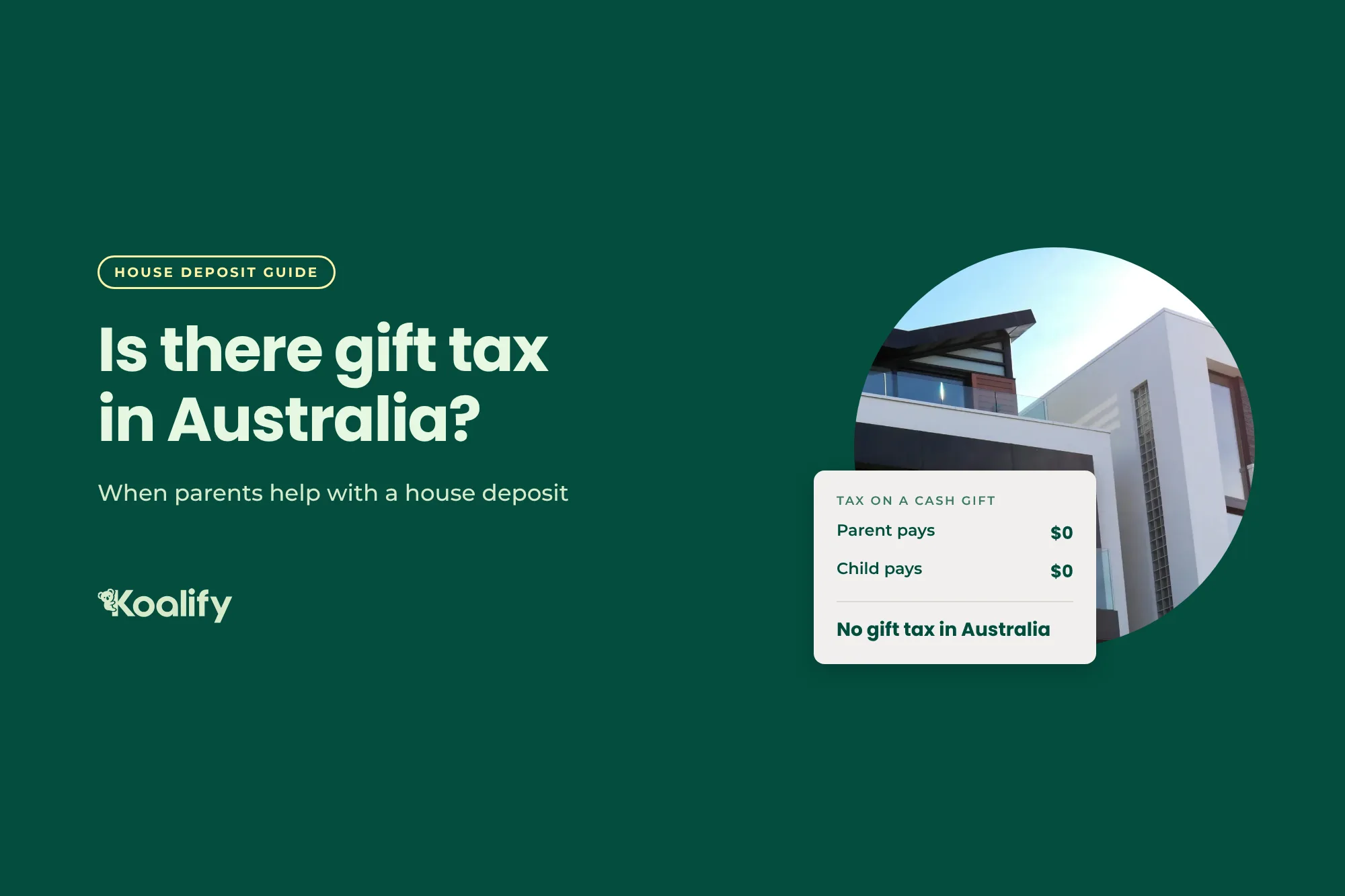
The short answer is no. Australia has no gift tax. If you give your child cash for a house deposit, you don’t pay tax on it and your child won’t pay any tax on the gift either.
A cash gift from a parent isn’t income for the person who receives it, so it doesn’t go on their tax return. Whether it’s $20,000 or $200,000, the ATO takes nothing from the gift itself. How good!
Where tax can come in is earlier: how you get the money in the first place. That’s where most parents gifting a house deposit get caught out.
Where tax can apply: selling assets to raise the cash
If you sell shares, an investment property or another asset to fund the gift, that sale is a normal capital gains tax (CGT) event. You pay CGT on the sale, exactly as you would if you sold for any other reason.
The gift doesn’t create the tax. The sale does. A few things are worth checking with your accountant before you sell:
Which asset you sell. Assets held longer than 12 months generally get a CGT discount for individuals.
When you sell. The gain is added to your income for that financial year, so timing can change how much you pay.
Losses you already have. Capital losses can offset the gain.
If the money is already sitting in savings, there’s no CGT to think about. Gifting cash you already have is the simplest version of this.
Why transferring the asset directly doesn’t avoid it
Some parents figure they’ll skip the sale and just transfer the shares or property into their child’s name. That doesn’t get around CGT.
When you give an asset away, the ATO generally treats it as if you sold it at market value. You can owe CGT even though no money changed hands.
With property there’s a second cost. A transfer between family members usually still attracts stamp duty, calculated on market value, and the rules differ by state. So you can end up with a CGT bill and a stamp duty bill, and your child still needs a loan for the rest.
In most cases, gifting cash is cleaner than gifting the asset.
What the bank needs for a gifted deposit
The lender will want proof the money is a genuine gift, not a loan. This is where I see deals slow down most often.
A signed gift letter or statutory declaration. It confirms the amount, who it’s from, and that it never has to be paid back.
Where the money came from. Expect to show bank statements tracing the funds from your account to your child’s.
Genuine savings. Some lenders still want the borrower to show their own savings history, especially with a smaller deposit, such as when buying under the 5% Deposit Scheme. Policies differ between banks.
If your child is self-employed, the lender will also look closely at how their income is assessed. Here’s how lenders assess self-employed borrowers.
Gift or loan: decide before the bank asks. If the money has to be repaid, it’s a debt. The bank will count those repayments and your child’s borrowing power drops. Calling a loan a gift on a bank form is a serious problem, so be clear about which one it is.
Gift, loan or guarantor: how each one changes the application
Gift | Family loan | Guarantor | |
|---|---|---|---|
What you give | Cash that never has to be repaid | Cash your child repays on agreed terms | Equity in your own home as extra security, no cash needed |
Effect on borrowing power | None, it counts as deposit | Repayments are counted as a debt, so it drops | None from you, though your child still has to afford the loan |
Your risk | The money is gone | Depends on your child repaying, and on how it’s documented | You’re liable for the guaranteed amount if your child can’t pay |
Best when | You can afford to part with it for good | You need the money back one day | You have equity but not spare cash |
Each option changes how the bank assesses the loan, and lenders treat family loans and guarantor loans differently. Work out which one you’re doing before you apply.
A real client example
A client came to me recently looking to buy in the Eastern Suburbs of Sydney. They were looking at a semi-detached property. Their parents wanted to help with a cash deposit, but they’d held off because they were worried about the tax. They’d heard different things from different people and didn’t want to create a problem for themselves or their child.
So we got everyone on the phone together with a financial planner, who walked them through it: there’s no gift tax in Australia, and a genuine cash gift doesn’t create a tax bill for either side. With that settled, the parents signed a statutory declaration confirming the money was a gift, with no repayment terms. The lender had everything it needed upfront, so the deposit never held up the approval. In a competitive Sydney market, that meant my client could move quickly and secure their dream home rather than lose it waiting on paperwork.
Two more things parents should check
1. Centrelink gifting rules and the Age Pension
If you receive the Age Pension, or will soon, Centrelink lets a single person or a couple gift up to $10,000 per financial year, and no more than $30,000 over a rolling five financial years. Anything above those limits is treated as a “deprived asset”. That means it still counts against you in the assets test, and is deemed to earn income, for five years from the date of the gift.
This also catches gifts made in the five years before you apply for the pension. So a $100,000 deposit gift at 63 can still reduce your pension at 67. Get this checked before the money moves, not after.
2. What happens if your child’s relationship ends
If you gift money to your child and they buy with a partner, that money can end up in the pool of assets split in a separation. If protecting it matters to you, speak to a family lawyer about the options before you hand it over.
Gift tax and house deposit FAQs
 Get in touch

Is there gift tax in Australia?
No. Australia has no gift tax. Neither the person giving nor the person receiving a cash gift pays tax on the gift itself.
How much money can parents gift for a house deposit?
For tax purposes, there’s no limit. If you receive the Age Pension or will apply soon, Centrelink’s gifting limits of $10,000 a year and $30,000 over five years apply.
Does my child have to declare a cash gift from me on their tax return?
No. A genuine gift from a parent isn’t assessable income. They’ll still need to document it for their lender.
Do I pay tax if I sell shares to give my child a house deposit?
Yes, if the sale makes a gain. Selling shares or property is a normal CGT event, regardless of what you do with the money afterwards.
Can I transfer my investment property to my child to avoid tax?
Generally no. A gifted asset is usually treated as sold at market value, so CGT can still apply, and property transfers usually attract stamp duty.
What does the bank need for a gifted deposit?
Usually a signed gift letter or statutory declaration confirming the money doesn’t need to be repaid, plus statements showing where it came from. Some lenders also want to see the borrower’s own savings.
Does gifting money affect my Age Pension?
It can. Gifts above $10,000 in a financial year, or $30,000 over five financial years, are counted as an asset for five years. This includes gifts made in the five years before you claim.
The bottom line
The gift itself is tax-free and simple. Getting it right comes down to three decisions: where the money comes from, whether it’s a gift, a loan or a guarantee, and how it’s documented for the bank.
Sort the paperwork out before your child applies for pre-approval, so the deposit never holds things up. If they’re buying for the first time, our first home buyer guide covers the rest of the process, including the grants and schemes they may be eligible for. Or book a free chat with me and I’ll walk you both through it.
About the author: Luke Patterson is a mortgage broker and the founder of Koalify, based in Sydney.
This article is general information only and doesn’t consider your personal objectives, financial situation or needs. It isn’t tax, legal or financial advice. Speak to your accountant about tax, a family lawyer about protecting a gift, and Services Australia or a financial adviser about pension impacts.
Sources
Related guides
How to Buy a House With a No Deposit Home Loan?
Thanks to different types of home loans in Australia, you can now get a mortgage with no deposit. Find out the 2 ways to get a zero-deposit mortgage and other low-deposit alternatives.
Read guide
Australia’s 5% Mortgage Deposit Scheme Kicks Off Early
Learn everything about the revamped Home Guarantee Scheme in Australia, including the updated timeline and eligibility.
Read guideApply for a Mortgage Online With Australia’s Zero-Fee Broker
Find out how to apply for a mortgage, the application requirements, and how we can help you from start to finish for free!
Read guideCompare rates from multiple lenders online.
Let our mortgage brokers secure the most suitable deal for you.